
A Living Treaty: the 2026 USMCA Review

The review of USMCA scheduled for July 1, 2026 is baked into the treaty itself (Article 34.7), with U.S. change proposals due to Congress by June 1. As of March 2026, all three countries are actively engaged in preparation for that review — a positive signal for the regional business community navigating an otherwise volatile trade environment.

The USMCA is a living document not just because it includes regular opportunities for review and update, but because it allows for interpretation mechanisms. Dispute settlement is one of them, seen in agricultural matters (e.g., GMO corn, settled) and in energy (e.g., market advantages granted to Mexico’s national electrical utility, still in dispute). Another is the treaty’s Rapid Response Labor Mechanism, which applies to labor complaints about Mexico facilities and can only be filed by the U.S. Government. Through the end of 2024 the mechanism saw 31 formal complaints and six panels, mostly regarding workers’ rights at Mexican automotive and manufacturing plants, but also at mines and a call center.

As a concrete indicator that the treaty remains active under Trump 47, on February 19, 2026 the USTR launched a review of USMCA automotive rules of origin. The minimum content for a vehicle to be considered North American is currently 75 percent, 40 percent of which must be made in the U.S. or Canada and must include core components like engines, transmissions, and chassis. Any proposals to change or maintain these thresholds will be addressed in July and factored into the USTR review, due in 2027.

The perspective from Mexico is that the review is a timely opportunity to revisit tough issues. The elephants in the room are Mexico’s energy relationship with the U.S., where all three parties stand vis-à-vis China, and — though not directly addressed by the treaty — organized crime. Various voices in Mexico have speculated that the review process will likely become drawn out, but not enough to destabilize the agreement. Kenneth Smith Ramos, former USMCA negotiator, recently discussed this on the Trucking Matters podcast. Juan Carlos Baker is another USMCA watcher who has assessed in depth the factors in play.
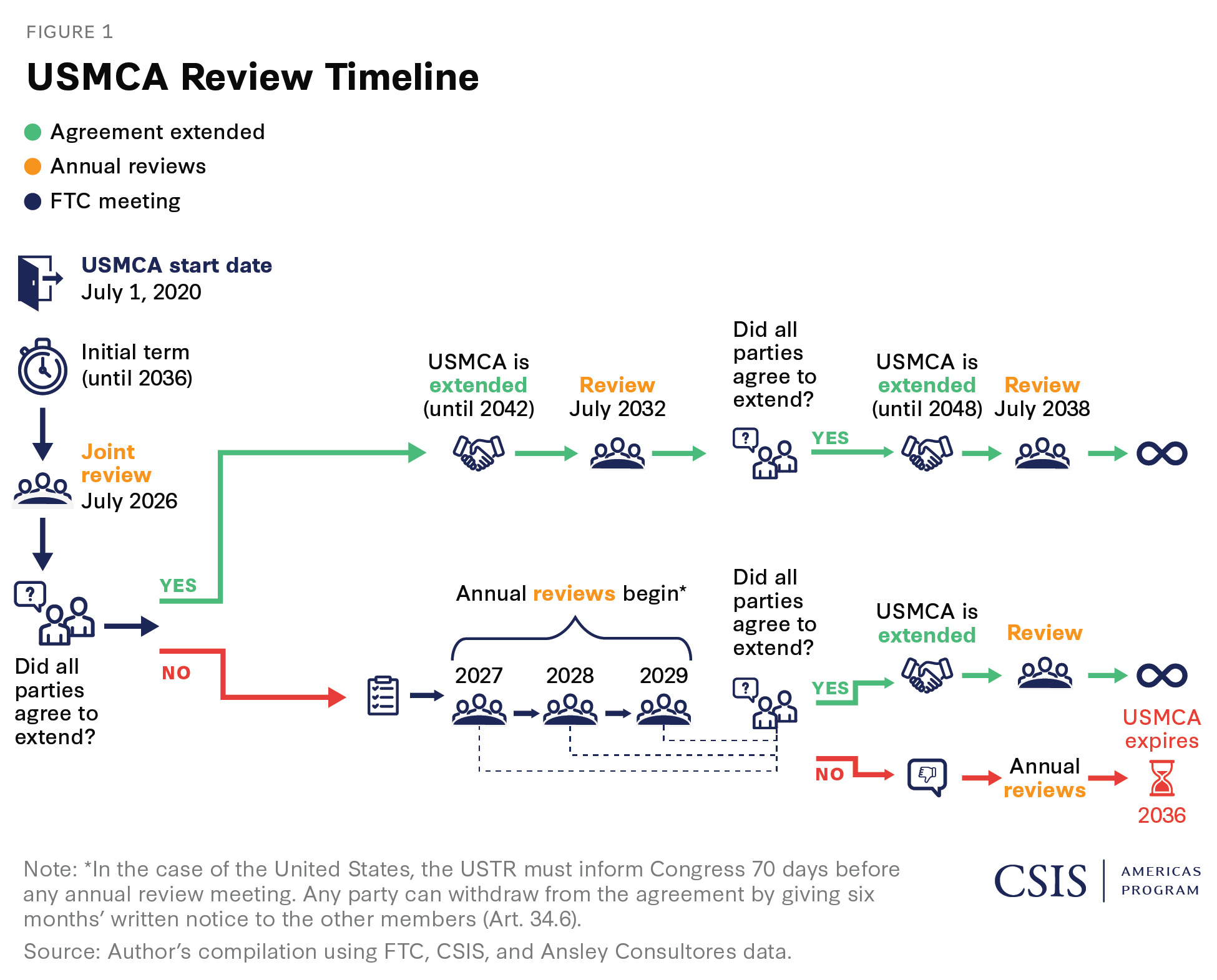
 

Source: Juan Carlos Baker and Diego Marroquin Bitar article on CSIS (www.csis.org/analysis/inside-mechanics-2026-usmca-review)

The USMCA as a Regional Stabilizer

While this year’s “talks” may take longer to finalize than desired, they are both mandated by the agreement and welcome. The more dynamic and relevant the agreement the better it is for the region, especially in the midst of such fast-paced changes as we are living in trade with the rise of AI, Mexico’s recent fever pitch to establish rule of law and protect its sovereignty, and the US’s internal wake-up calls with respect to semiconductor and other manufacturing self-reliance.

Mexico-US Security Cooperation

The most important fundamental is this rule of law struggle. The US has clearly demonstrated in its actions, as far back as the GW Bush administration and now under Trump 47, that it considers the situation with Mexican-controlled organized crime groups a binational, shared problem. With Trump’s nomination in late 2024 of Ambassador Ron Johnson, the US showed that it was tapping into the experience of serious, well-informed and well-prepared advisors on the matter, which is normally framed as “stopping fentanyl trafficking.”

Meanwhile, considering Trump’s tendency to condition trade on his desired outcomes in diplomatic issues, it seems to follow that if the US’s anti-cartel cooperation with Mexico continues to succeed, Trump may be more likely to publicly “reward” Mexico’s position as the most important trade partner to the US. In that case, a re-affirmed and updated USMCA would be the path of least resistance for doing so. Indeed, the strength of Mexico’s economy and what it can contribute as a trade partner depend in very critical ways on reining in the influence of organized crime in Mexico. If US-Mexico trade has performed well in Mexico’s environment of the last 20 years, imagine what Mexico as a trade partner could do with a healthier rule of law environment.

Industry Opinion and Industrial Policy

The industrial policy outcomes desired by the US are less clearly demonstrated by the US Federal Government. It wants to “bring manufacturing jobs back” to the US, yet the proponents of automation, who are the technological voice of our times, seem to have the administration’s ear. On the other hand, the objective of the US from the perspective of the US business community: please create regulations that are predictable and stable. From a USMCA lens, that generally means let’s keep up the North American market integration we have been investing in since NAFTA in 1994. Specific comments can be reviewed in the USMCA public docket section of the USTR’s website, with a separate comments section specifically for automotive. One of the most resounding success cases of that integration is the interconnected North American manufacturing platform, but also agriculture and services. The concrete common ground among these goals, of the companies and of the US Government, may be how to remain competitive with China. On AI, on automotive, on electronics, on infrastructure investment. These are topics that can all be addressed in July and with a little work, adopted as updates to the existing USMCA agreement.

Mexico, just like the US, conducted work groups to consult with industry. 30 sessions since September 2025, and recently reported that 83 percent of the parties consulted by the Secretariat of the Economy view the treaty as positive or very positive. The stakeholder consultations led by Economy, including two we attended through AmCham Mexico, emphasized streamlining customs procedures, harmonizing documentation requirements, improving border infrastructure, and reducing non-tariff barriers. Mexico is also supposed to want clarity on the labor rapid response mechanisms, to ensure transparency in the future. Various spokespeople we hear at Economy have referenced the US’s list of USMCA “concerns” (often citing he term in English) over the last several months. Marcelo Ebrard, Mexico’s Secretary of the Economy, now notes that nearly all 54 of those points have been resolved during continuous talks.

Ebrard is travelling to Washington again March 16, and he is expected to focus on proposals to eliminate or lower tariffs, as well as to take the US and Canada’s interest in increasing regional content as a chance to deepen supply chain integration not just in automotive but also in sectors like electronics, medical devices, and textiles. In general Mexico will look to advance regional supply chain coordination, critical minerals cooperation, and industrial policy alignment to reinforce Mexico’s role as a manufacturing hub.

With regards to the other two elephants in the room besides security, Mexico may seek clearer interpretive understandings on energy to reduce the risk of future disputes on Mexico’s energy sovereignty. On the topic of China, Mexico in 2024 and 2025 already began stepping up country-of-origin verification and customs enforcement, for rule of law and transparency reasons but also in alignment with increased pressure from the US to enhance compliance. It may seek to use that cooperation to protect its ability to allow lawful and compliant foreign investment coming from China, which is a trend also likely to help Mexico consolidate its role as North American manufacturing hub.

Public Statements on the USMCA Review

Examples from US industrial associations.

Group Link to Policy Position / Task Force Microsite
National Association of Manufacturers The U.S.-Mexico-Canada Agreement: Evaluating North American Competitiveness; Read our letter to the U.S. Trade Representative (USTR) on the operation of the USMCA; The Promise of the USMCA
American Chemistry Council Joint Recommendation from the Combined North American Chemical Industry; USMCA/CUSMA/T-MEC Sectoral Working Group on Chemicals
Semiconductor Industry Association SIA Comments on USTR’s Joint Review of USMCA
Agricultural Coalition of USMCA United States-Mexico-Canada Agreement Works for America
Information Technology Industry Council Ahead of USMCA Review, ITI Sends USTR New Recommendations
The Business Council for Sustainable Energy North American Trade Policy Is Under Review in 2026. Here’s Why Energy Businesses Should Pay Attention
American Apparel and Footwear Association AAFA Testimony Endorses USMCA as Strong, Stable, and Vital
A coalition of 500 US business and agriculture organizations Coalition Letter in Support of the U.S.-Mexico-Canada Agreement
Automotive Industry Action Group The United States-Mexico-Canada Agreement (USMCA) is an update to NAFTA that impacts billions of dollars’ worth of interregional trade. AIAG’s USMCA Work Group comprises OEM and tier 1 supplier volunteers
US Lumber Coalition U.S. Lumber Coalition Calls on Trump Administration to Scrap USMCA Binational Panel Review System
Small Business & Entrepreneurship Council By securing stronger IP commitments from Mexico and Canada during the 2026 joint review, USTR can help realize President Trump’s original intent for the USMCA