

Not counting petroleum and natural gas, the US exported 207 billion USD worth of products to Mexico in 2023. Of the top 20 commodity classifications exported, 16 were vehicles, machinery and instruments, or manufacturing inputs such as plastics, chemicals, yarns and metals, a dollar value of 143 billion USD. That doesn’t count inputs for food processing that also appear in the top 20 (cereals, meats). (Source: US ITC DataWeb.)
Well over half of the non-petroleum US exports to Mexico are destined for the production of other end products. This paints a numeric picture of the nature of the US trade relationship with Mexico: industrial and manufacturing with a strong element of automotive. That the relationship es así is a direct result of the North American integrated supply chains, which have grown in complexity since 1994 when NAFTA was implemented. Unless subjected to a severe disruption, the melding of the US, Canadian and Mexican markets– first industrial and manufacturing, but also eventually consumer– is an unstoppable force to the immovable object that is our separateness as countries.
Source: Star Trek Discovery via Tenor.com
Incidentally, this is among the reasons we’re not super worried about tariffs breaking the relationship. Another is the appointment of Ambassador Ron Johnson as US Ambassador to Mexico.
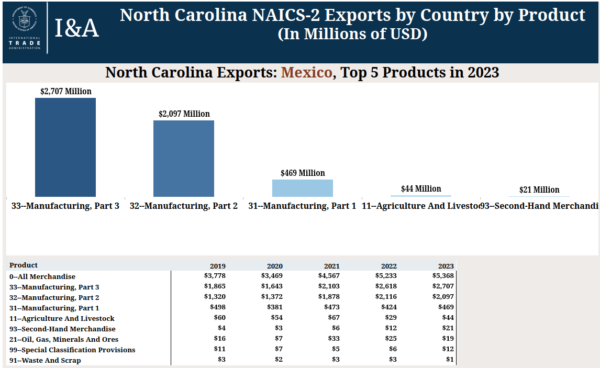
Source: US ITA TradeStats Express
The case of supply chain integration between NC and Mexico is equal or more intense than that of the US overall. All this to say that Mexican manufacturing indeed is a strong and likely still growing export market for NC companies, and also that NC manufacturing is a strong and likely still growing export market for Mexican companies. We recently prepared some information for an NC company in production machinery, to show the market size for manufacturing in Mexico overall.
To keep perspective on Mexico as a market versus other Latin America markets, remember that Mexico is indeed Latin America, but it is also North America. Mexico is a smaller economy than Brazil, but it punches above its weight in manufacturing due to higher volume focused on manufactured exports.
Manufacturing is about 18% of the total economy in Mexico (vs about 10% of the US economy). There are about 60,000 companies in Mexico manufacturing that have over 10 employees each, and key manufacturing segments in Mexico reported over 1 billion USD in supply purchasing over the last year.
Industry
Subcategories
Number
of companies
Non-CAPEX Supplies Nov 2023 -Oct 2024
(18 MXN = 1 USD)
Examples
Food Industry
Food production, beverages, and tobacco
196,000
202 million USD
Corn mills, bottling plants, meat processors
Metal Product Manufacturing
Tools, metallic structures, and metal articles
67,000
203 million USD
Metalworking shops, structure manufacturers
Textile, Apparel, and Leather Manufacturing
Spinning, weaving, garment production, leather tanning
55,000
32 million USD
Cut and sew operations, footwear factories, technical textiles
Furniture and Wood Industries
Furniture, carpentry, and derivative materials
52,000
51 million USD
Carpentry shops, furniture manufacturers
Chemical, Plastics and Rubber Industries
Production of chemicals, and plastics and rubber products
26,600
239 million USD
Plastic manufacturers, adhesives, and pharmaceutical
Printing and Related
Books, periodicals and magazines
18,000
22 million USD
Printing presses
Paper and Related Products Industry
Paper, cardboard, and printing products
1,300
42 million USD
Printing shops, cardboard packaging factories
Machinery and Equipment
ManufacturingAgricultural, industrial, electrical, and electronic machinery
800
64 million USD
Engine manufacturers, medical equipment, heavy machinery
Automotive Industry
Passenger vehicle and truck production, auto parts, and accessories
734
287 million USD
Assembly plants (OEMs), Tier 1 and Tier 2 suppliers
The above information on manufacturing segment size indicators comes from Mexico’s national statistical institute, including its national economic census and economic information database.