

Companies around the world are wondering if they should go on standby with international business initiatives given a possible paradigm shift if pronounced tariff barriers were enacted by the United States. In Mexico’s case, however, we like to point out that the country can be quite adept at “managing up” when it comes to dealing with the US. Our favorite trade annals example is when Mexico approached US Senators from Oregon about hefty tariffs on certain species of Christmas trees, as a way of requesting those members of Congress help remove obstacles Teamsters had in place on Mexican truckers entering the US. Which is to say Mexico’s reaction to recent threats by the incoming US Government to impose tariffs on Mexico seems to treat the matter as a routine challenge, citing talking points it has addressed regularly in conversations with the US since the Obama administration. Below are the comments of Mexican President Claudia Sheinbaum, from her daily morning press conference of Tuesday, November 24.
Before addressing this morning’s health topic, I want to share with you the letter that I am sending today to President-elect Donald Trump.
Dear President-elect Donald Trump,
I am writing to you regarding your statement on Monday, November 25, about migration, fentanyl trafficking, and tariffs. You may not have been informed that Mexico has developed a comprehensive aid policy for migrants from various parts of the world crossing our territory with the aim of reaching the southern border of the United States. As a result, and according to figures from your country’s Customs and Border Protection (CBP), encounters at the Mexico-U.S. border have decreased by 75% from December 2023 to November 2024. (Incidentally, half of those arriving do so through a legally granted appointment under the U.S. program known as CBP One.) Migrant caravans no longer reach the border.
Even so, it is clear that we must jointly move towards a new model of labor mobility that is necessary for your country and address the root causes that compel families to leave their places of origin out of necessity. If even a fraction of what the United States spends on war were directed toward building peace and development, the underlying issues driving migration could be addressed.
On the other hand, and for humanitarian reasons, Mexico has always expressed its willingness to help curb the fentanyl epidemic in the United States, which, moreover, is a consumption and public health issue within your society. This year, Mexican Armed Forces and prosecutors have seized tons of various drugs, 10,340 weapons, and arrested 15,640 individuals for drug-related violence. A constitutional reform is currently being processed in our legislative branch to classify the production, distribution, and commercialization of fentanyl and other synthetic drugs as a serious crime without bail. However, it is publicly known that the chemical precursors used to produce these and other synthetic drugs enter Canada, the United States, and Mexico illegally from Asian countries, making international collaboration urgently necessary.
You should also be aware of the illegal trafficking of firearms from the United States into Mexico. Seventy percent of the illegal weapons seized from criminals in Mexico come from your country. We do not produce these weapons, nor do we consume synthetic drugs. Tragically, the lives lost to crime in response to your country’s drug demand are ours to bear.
President Trump, migration and drug consumption in the United States cannot be addressed through threats or tariffs. Tackling these significant challenges requires cooperation and mutual understanding. A tariff would be met with another in retaliation, and this cycle will eventually endanger shared businesses. For example, some of the main exporters from Mexico to the United States are General Motors, Stellantis, and Ford Motor Company, which arrived in Mexico 80 years ago. Why impose a tax that puts them at risk? This is unacceptable and would cause inflation and job losses in both the United States and Mexico.
I am convinced that the economic strength of North America lies in maintaining our trade partnership. This will allow us to remain more competitive against other economic blocs. I believe that dialogue is the best path to understanding, peace, and prosperity for our nations. I hope our teams can meet soon.
Sincerely,
Claudia Sheinbaum Pardo
Constitutional President of the United Mexican States
We will send this letter today. As you can see, we are proposing a dialogue with President Trump’s team. Tomorrow, we will host a business council that we have been organizing for some time, coordinated by Altagracia Gómez, and the Secretary of Economy, Marcelo Ebrard, will also join. First, we will present the potential economic impact on the United States if tariffs were to be raised. We’ll show how this would affect the U.S. economy and, additionally, the work we have been doing for some time on what we call Plan Mexico—the plan for shared prosperity. Tomorrow, we will share a preview, and this will be officially presented next week at an event on Thursday, December 5, so you can all learn about it.
We note in the President’s comments the idea of competing against other economic blocs, showing that she believes in continuing the path of North American economic integration that began formally with NAFTA in 1994. Plan Mexico‘s key advisors from the business community were announced the next day as the Regional Economic Development and Relocation steering committee and will work alongside the Mexican Government on the USMCA renegotiation pending for 2026. Other elements of the plan include 100 industrial parks around the country in strategic locations, to diversify where growth is driven within Mexico, including to enhance Mexican-originated capital investments. While the named steering group is comprised entirely of Mexican-held companies, most of the companies represented have staked a large part of their success on trade with the US.
The steering committee members:
- Grupo Minsa (Altagracia Gómez Sierra)
- Dalia Empower (Gina Díez Barroso Azcárraga)
- Almacenes Distribuidores de la Frontera (Myriam Guadalupe de la Vega)
- Softtek (Blanca Treviño de Vega)
- Grupo Collectron (María Elena Gallego)
- Miraplastek (Concepción Miranda)
- Banco Multiva (Tamara Caballero)
- MAJA Consulting Group (Ana María Macías)
- Genomma Lab (Rodrigo Herrera Aspra)
- Grupo Kaluz (Antonio del Valle Perochena)
- Palace Resorts (José Chapur Zahoul)
- Grupo Lala (Eduardo Tricio Haro)
- Deacero (Raúl Gutiérrez Muguerza)
- José Cuervo (Juan Domingo Beckmann)
- Grupo Alfa (Armando Garza Sada)
The American Chamber of Mexico (of which our office is a member) as well as the Consejo Coordinador Empresarial are also participating in the council.
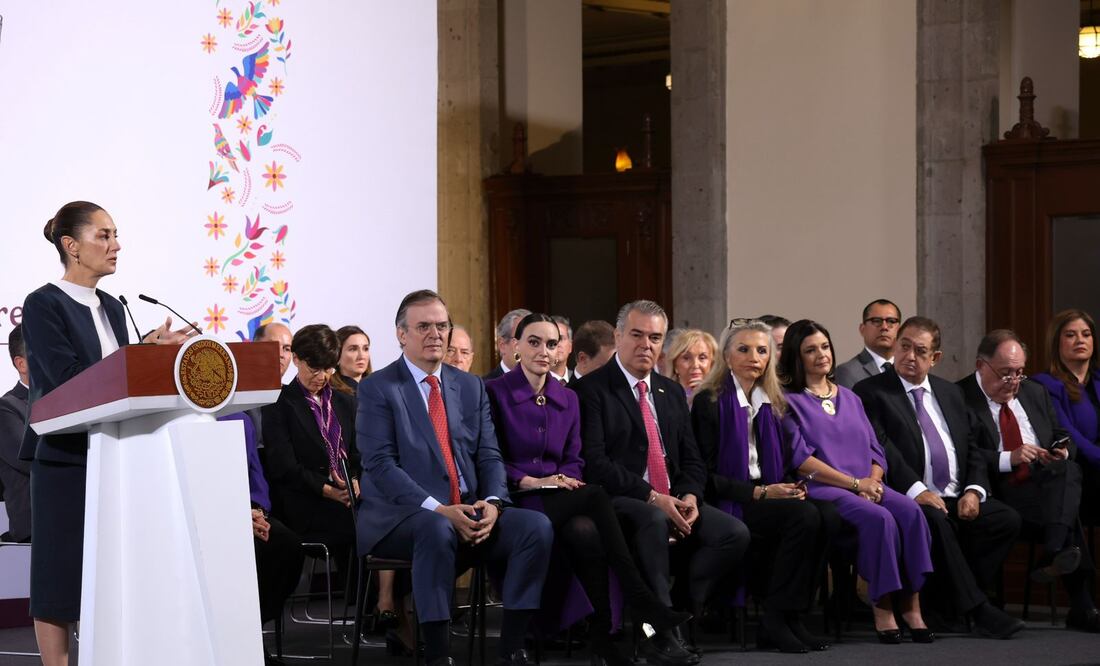
Image: President Sheinbaum, Secretary of Economy Marcelo Ebrard, and members of the CADERR committee. (Source: El Universal newspaper)