

The most important thing happening to Mexican business right now is not preparations for the World Cup nor shake-ups in global manufacturing. It is the decisions Claudia Sheinbaum and her ruling Morena party are making regarding how thoroughly to purge (or not) the influence of organized crime cartels from Mexico’s ruling classes.
A heavy topic, but the even larger question is whether Mexican leadership is working towards reform of the corrupt corporatist system inherited from the 20th century PRI party dictatorship. In its unbroken reign of 71 years, the PRI party cultivated profession-based political machines to maintain voter majorities. Transportation workers, electricians, teachers, and petroleum industry workers organized into what were nominally labor unions, but rather than worker protection were dedicated to consolidating political power for the PRI. Those groups lost their allegiance to the PRI when it finally lost its dominance, and they have remained to serve whomever in power is willing to use them.
Vicente Fox “broke” the PRI monopoly in 2000 by, as an opposition party candidate (PAN), getting elected president. He had a genuine agenda to reform corruption, including the growing influence of organized crime, but the PRI still ran the legislature and the political machines their corresponding spheres of influence.
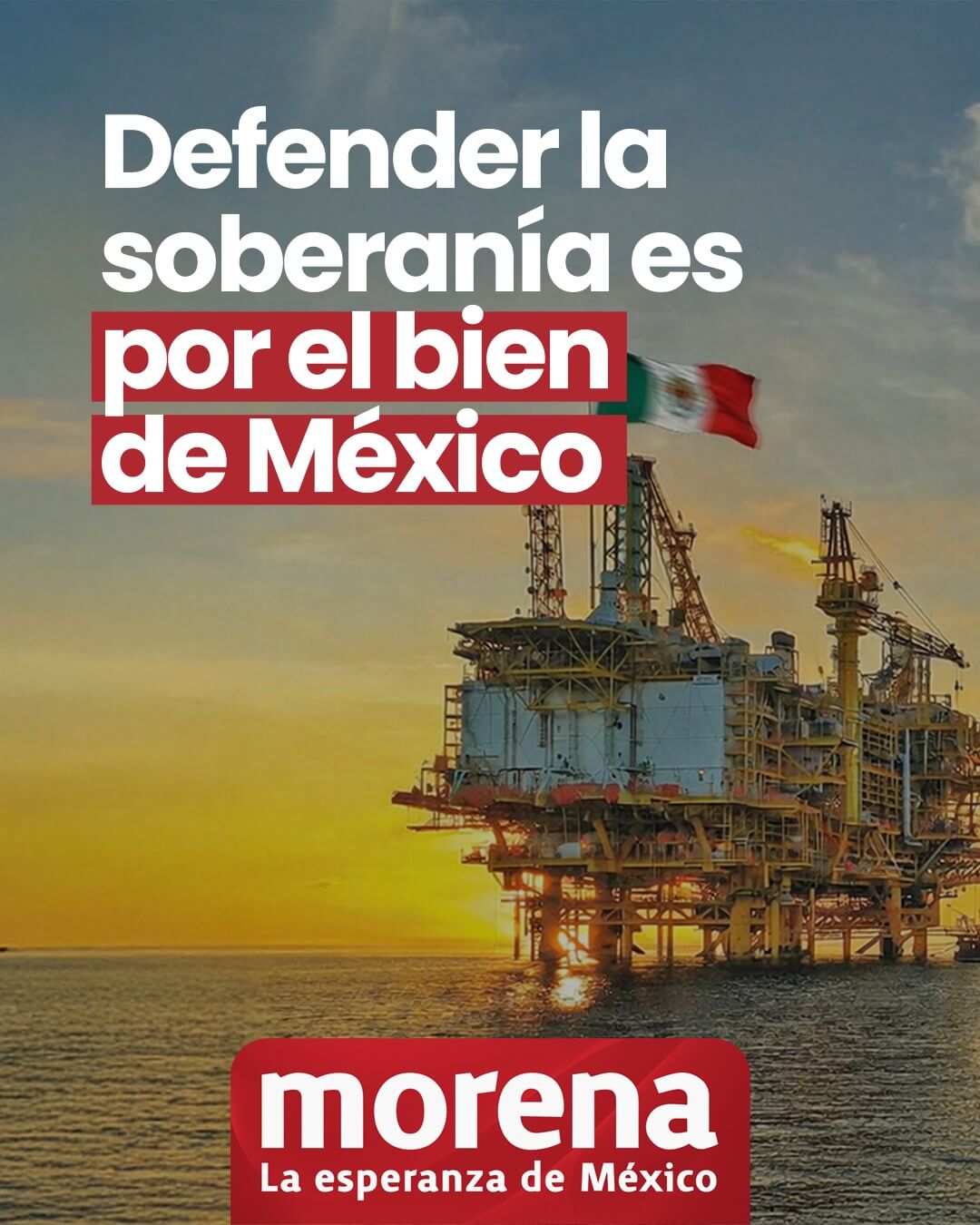
Image from the PartidoMorenaMX Facebook page: “Defending sovereignty is for the good of Mexico”
Following the Fox administration came another Panista, Felipe Calderon, widely recognized for his genuine desire for reform. Unfortunately by that stage (2006) reform needed to first deal with the narcos. Accordingly, Calderon directed confrontation of organized crime groups by a (now-defunct) Federal Police corps and the military, with backing from the US. The effort was violently unsuccessful. The PRI president who followed him, Enrique Peña Nieto, elected in 2012, put Calderon’s unpopular drug war on the back burner in favor of a focus on energy, which AMLO continued when he entered office in 2018. The drug war stayed on that back burner, still boiling, into the Sheinbaum administration.
With AMLO, however, something changed. The 30-percent margin of victory in his presidential election came with the pledge to reverse the Peña Nieto government’s complicity towards the narcos, yet he went further than simply ignoring the narco problem. Real criminal allegations now exist that Morena, under his leadership, actively folded narcos into its political machine, alongside the teachers, electricians and the transport workers.
Sheinbaum is now faced with an even worse narco problem than her predecessors. The US bringing the problem of their influence out in the open (when so many Mexicans who tried to do the same have been ignored) has brought systemic corruption– the same reason the PRI lost power 26 years ago– back to the forefront of national conversation. In that sense, President Sheinbaum has the opportunity to make history, even more so than Vicente Fox. Will she, though?
There have been signs since she entered office: the appointment of Omar García Harfuch as head of federal law enforcement; the shaking out of lower-level overtly corrupt officials. Since late 2024, Sheinbaum’s administration has arrested some 147 individuals across multiple states, including sitting and former mayors and municipal security directors, showing a willingness to go after her own party that her predecessors lacked. As of January 2026, about 30 percent of those arrested had been convicted. This is quite high for Mexico, where the average rate of successful prosecution is around 7 percent.
In late April, the US announced it would seek extradition of the Governor of Sinaloa and 9 other sitting officials for their cartel connections. In response, the Mexican administration on the surface may be seen as dragging its feet. They can either hand over the individuals the US seeks, or more satisfyingly to most Mexicans, prosecute and convict them in Mexico. Nevermind that leading effective law enforcement against officials that high up (and the US threatens there are more to come) would burn bridges for her. Doing so could become life-threatening to people around her. The extent to which her and her circle’s livelihoods are put in danger would depend on how successful such law enforcement campaigns turned out to be. With or without real US support, that is a gamble.
But why would the US want to support these prosecutions? Why the pressure on Sheinbaum, the extradition orders? Beyond the political goals of the current US presidential administration, the business community in Mexico, including many US companies here, and the larger community of the integrated North American market, see one fundamental reason really clearly and has for a long time: the main obstacle to productivity in Mexico is failed rule of law; impunity due to the influence of organized crime and an inherited corrupt system. Following that main obstacle are other persistent obstacles related to energy, education, and transportation. Areas historically underdeveloped thanks to being appropriated for political gain. The US wants Mexico to reform, because that will help its economic growth. The expectation to make Mexico a better customer, supplier, investor and neighbor in an increasingly interdependent North American bloc.
Since Sheinbaum took office, the word “sovereignty” is a recurring affirmation in Morena party talking points. Sheinbaum says it all the time, as do Morenista senators and congressmen. Their repetition of the term can feel tiring. It gives the impression that they believe Mexico’s sovereignty is under attack, whether by the US, the narcos, or the political machines. If the word is being held up with enough self-awareness though, by enough people in the Morena party, then maybe there is hope that Sheinbaum will be able to do the right thing and survive.